A1
English Vocabulary Exercises for A1 – Daily routine
13 exercícios
A1 (Iniciante) vocabulário - "English Vocabulary Exercises for A1 – Daily routine". 13 exercises. Grátis, sem cadastro.
1. Complete the phrases with the verbs below.
- arrive get go have (x3) leave wake
- 1)up
- 2)dressed
- 3)breakfast
- 4)at school
- 5)lunch
- 6)school
- 7)dinner
- 8)to bed
2. Look at the pictures and label the times. Use the phrases in the table.
| one, two … twelve o’clock | ||
| five / ten / quarter / twenty / twenty-five | to / past | one, two, three, four, … ten, eleven, twelve |
| half | past |
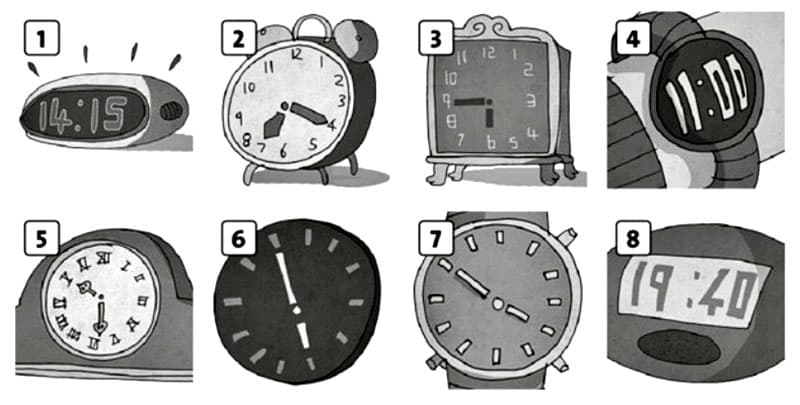
- 1)
- 2)
- 3)
- 4)
- 5)
- 6)
- 7)
- 8)
3. Listen and draw the times on the clocks.
Audio
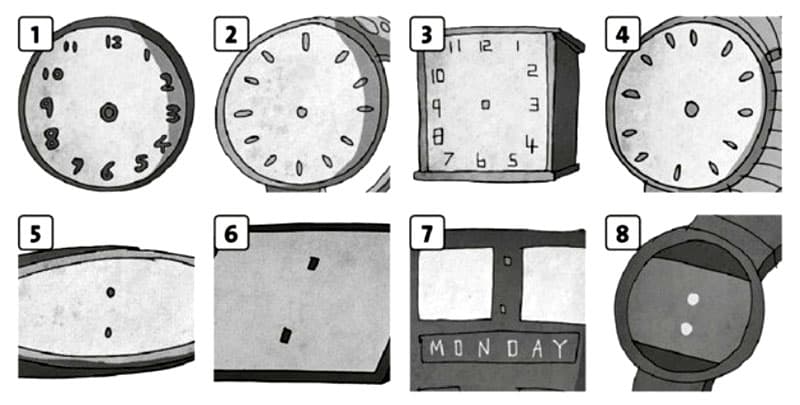
4. Choose five verbs from exercise 1. Write sentences saying what time you do these activities on a normal school day.
- 1)I wake up at half past seven.
- 2)
- 3)
- 4)
- 5)
- 6)
5. Label the lessons with six of the school subjects below.
- art and design biology chemistry economics English
- French geography German history I.C.T maths music
- P.E. physics R.E.
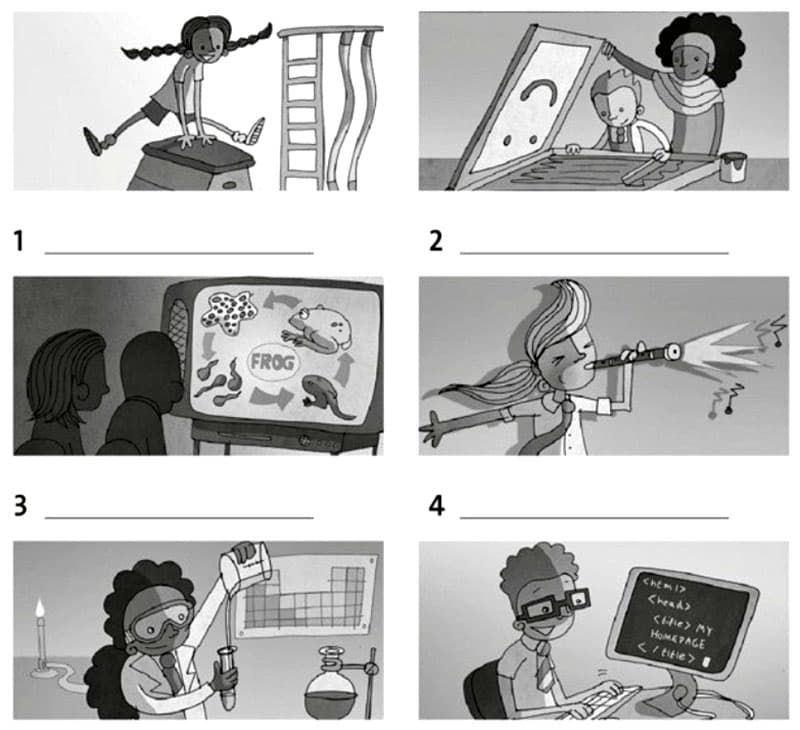
6. Listen. What lesson is it? Choose four other subjects from exercise 5.
Audio
- 1)
- 2)
- 3)
- 4)
7. Write your school timetable for Monday. Include the times for each lesson and your breaks.
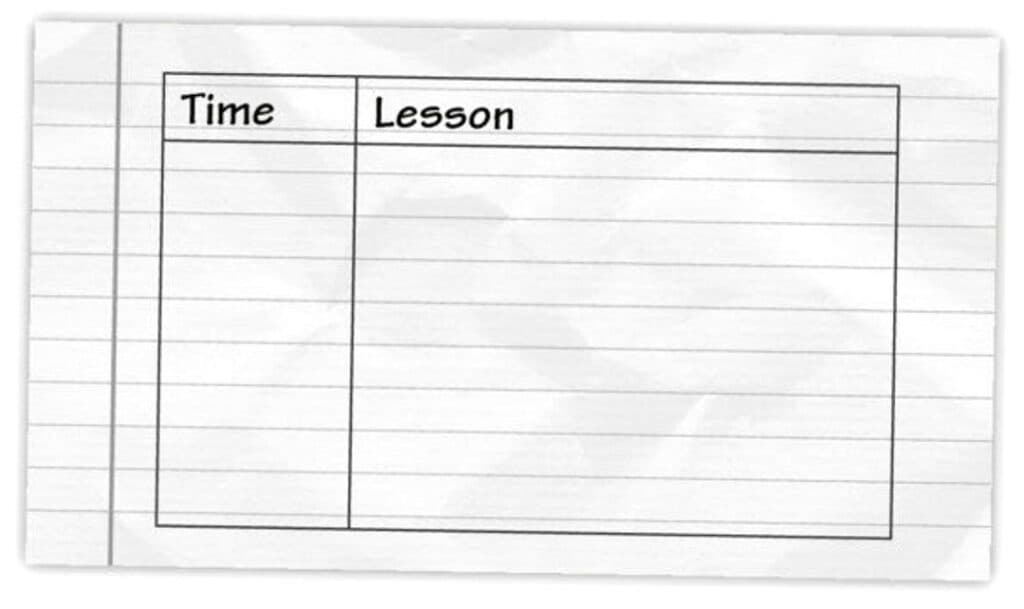
8. Answer the questions about your timetable in exercise 7.
- 1)Do you have English on Monday?
- 2)What time is your first lesson?
- 3)What time is your last lesson?
- 4)How many breaks do you have?
- 5)Do you enjoy this day? Why? / Why not?
Extra exercises
9. Complete the daily routine phrases in the text. Write one word.
- I 1) up at 7.20 a.m. during the week, and I get up at 7.30. First, I have a shower and then 2) dressed. Next, I 3) breakfast. I usually walk to school. I 4) at school at 8.30 a.m. In the afternoon, I 5) school at 2.30 p.m. After that, I do my homework and see friends. I 6) to bed early because I have to go to school the next day.
10. Complete the definitions with school subject.
- 1)is the study of numbers, measurements and shapes.
- 2)is the study of the way people and countries spend money and make, buy and sell things.
- 3)is the study of things that happened in the past.
- 4)is the study of the Earth and everything on it, such as mountains, rivers, land and people.
- 5)is the study of the life of animals and plants.
11. Complete the second sentence using the opposite of the adjectives in the first sentence.
- 1)China is a large country.
- Andorra
- 2)During the day, New Orleans is safe.
- At night,
- 3)This road is very wide.
- That path
- 4)Summer is Portugal is usually dry.
- Winter in Portugal
12. Complete the sentences with the words below.
- boat bridge jungle mountain river valley
- 1)The Golden Gate is in San Francisco.
- 2)The Thames is in London.
- 3)Kilimanjaro is a in Tanzania.
- 4)The river in the bottom of this is called the Rhine.
- 5)The Amazon rainforest is a large in South America.
- 6)The only way to visit the Statue of Liberty in New York is by
13. Choose the correct answers.
- 1)Emma is She wants to go to bed.
- a angry
- b sad
- c)tired
- 2)Max is He can’t find his phone.
- a happy
- b embarrassed
- c worried
- 3)We’re Our holiday starts tomorrow.
- a excited
- b worried
- c angry
- 4)I’m I can’t remember your name.
- a tired
- b embarrassed
- c happy
- 5)The teacher is All the students are late.
- a angry
- b excited
- c happy
- 6)Charlotte’s She doesn’t like her new school.
- a excited
- b sad
- c tired
Como praticar
- 1Leia cada pergunta cuidadosamente
- 2Escreva sua resposta ou selecione a opção correta
- 3Clique em 'Mostrar Resposta' para verificar seu trabalho
- 4Revise quaisquer erros e tente exercícios similares
- 5Passe para o próximo exercício quando estiver pronto
Exercícios de prática relacionados
Aprenda com aulas
Construa sua base com aulas de áudio e vídeo