Inventions that save lives: A2 okuduğunu anlama
“Inventions that save lives” konusunda cevaplı 5 A2 alıştırma (Okuma). Her görevi tamamlayın ve hemen kontrol edin. Ücretsiz, hesap gerekmez.
Başlamadan önce. 5 alıştırma. Her metni okuyun, sonra soruları cevaplayın.
Alıştırma 1. Complete the sentences with nouns formed from the verbs and adjectives below in brackets.
8 boşluk- 1The Hubble telescope can measure the (move) of distant galaxies.
- 2The city centre was destroyed in the war. The (reconstruct) took many years.
- 3Hard disk recorders allow us to make (record) of TV programmes.
- 4Many men hope doctors will invent a cure for (bald).
- 5The aeroplane is a wonderful (invent).
- 6That’s a lovely flower (arrange).
- 7Beethoven suffered from (deaf) during the last 25 years of his life.
- 8Before the (discover) of American in 1492, many people thought the Earth was flat.
8 sorudan 0 tanesi cevaplandı
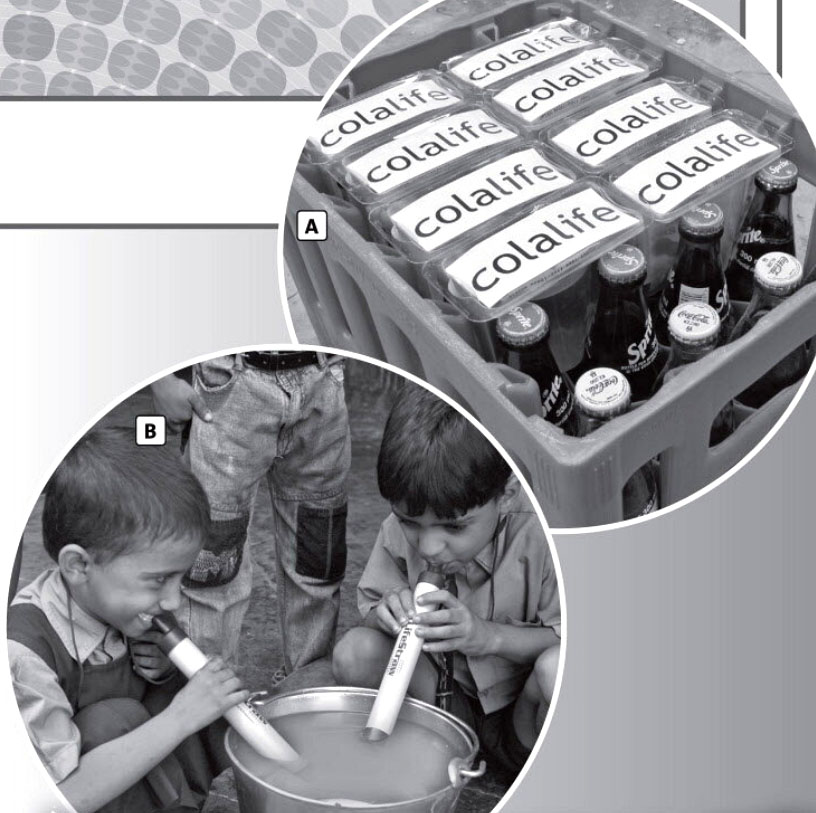
Alıştırma 2. Read the texts and match two of the inventions with the photos (A-B).
3 boşluk- 1Hippo-Roller, photo
- Many women and children in Africa spend between three and nine hours a day carrying water to their homes. They use 20-litre plastic buckets, which they carry on their heads. The buckets are very heave and often cause back and neck injuries. So engineers Pettie Petzer and Johan Jonker designed a ‘rolling wheel’ which can carry ninety litres of water and is much easier to move. 33,000 ‘Hippo-Rollers’ have been made and delivered to remote villages in Africa. The results are good: women have more time to look after their families, the children have more time at school, and there are fewer injuries.
- 2LifeStraw, photo
- There are 780 million people in the world who don’t have clean safe drinking water. This fact led the Swiss company Vestergaard to invent a special kind of straw that allows people to drink dirty water without getting ill. The LifeStraw is a long thin tube that cleans the water as it passes through into somebody’s mouth. LifeStraw is very light and can clean up to 1,000 litres of water before you need to replace it. LifeStraw was used to help people after the Haiti earthquake, and floods in Pakistan and Thailand.
- 3AidPod, photo
- When Simon Berry was travelling in Zambia, he noticed that he could buy Coca-Cola in the remotest villages. But in these same villages the people had no medicines and, because of that, one in five children were dying before their fifth birthday. He had an idea. ‘Why don’t they bring medicines when they deliver the Coca-Cola?’ So he invented the AidPod, a triangular packet of medicines that fits between the bottles in a crate of Coca-Cola. Berry has experimented with a number of designs for his AidPod and is testing his ideas in Zambia. If his plan works, he hopes to do the same thing in other African countries, and save thousands of lives.
Alıştırma 3. Read the Reading Strategy. Then decide if the sentences below are true (T), false (F) or ‘does not say’ (DNS).
Reading Strategy
Sometimes, true / false tasks include a third option: the text does not say. Choose the third option if the text does not contain enough information to clearly say if the sentence is true of false. Do not use your own knowledge (or guesswork) to fill any information gaps!
- 1Carrying water on your head can cause neck injuries.
- T F DNS
- 2With the Hippo-Roller people can carry more water than with a normal bucket.
- T F DNS
- 3The LifeStraw is made from natural materials.
- T F DNS
- 4The LifeStraw never stops working.
- T F DNS
- 5The Coca-Cola company worked with Simon Berry to design the AidPod.
- T F DNS
- 6The AidPod is used successfully in many different countries.
- T F DNS
Extra exercises
Alıştırma 4. Read the Strategy. Then read the first main paragraph of the text and the first question. Choose the correct option and find the part of the text that gives you the answer. Why are the other options wrong?
Strategy
When you are answering questions about specific information, remember that you will always find the information in a specific part of the text. It helps to note the parts of the text that give you the information so that you can check your answers at the end.
Alıştırma 5. Now read the whole text. Choose the correct answers (A-D).
5 boşluk- Mark Harris is a research scientist at Rothera Research Station, on Adelaide Island in the Antarctic. We asked Mark what were the best and the worst things about living in the Antarctic.
- ‘The best thing about being here is the wonderful view,’ Mark said. ‘On my first day, I was unlucky because I was ill and had to spend a few days in bed. The station’s doctor thought I’d eaten something bad at home, or in the station canteen, but I didn’t even go to the canteen. I think it was the meal I had on the journey across – it didn’t taste right to me. And so I was pretty miserable at the beginning. But then I lay in bed during those first days and watched icebergs drifting past my window. It was amazing! In summer, I like to be outside as much as possible. One of my jobs is to fly around with other scientists in a helicopter making observations and checking on experiments. We fly over the most fantastic places. Our pilots are really skilled. They can land anywhere – even on glaciers!’
- ‘I try not to think about the bad things, but there are some, of course. I like the food – it’s actually really good – but we don’t have fresh fruit and vegetables. I often think about the countryside: the green grass, the trees, and the flowers. I always look forward to seeing it again. But Rothera is great because there’s always someone to talk to if you’re feeling unhappy, and someone will always help you with a difficult task. But at the same time people understand when you want to be alone.’
- ‘There’s always plenty to do as well. You might think that living in the middle of so much snow is boring, but it isn’t at all. On good days I like to ski and snowboard, and watch the wildlife. I play badminton and table tennis at the station, and some nights I go to the gym, so fitness isn’t a problem. We have video nights and games nights, and we even have cookery and woodwork lessons. I’ve actually learned some great new skills since I’ve been here. I’ve also had two holidays, camping. Of course, I’d like to have may friends and family with me, and I always think about that, but that can’t happen for a while. I have to be patient. All in all, being at Rothera is a great experience.’
- 1Mark thinks he ate something bad
- a)Afew days after he arrived at the station.
- Bduring his trip to the station.
- Cbefore he left home.
- Don the day he arrived at the station.
- 2During the summer months, Mark
- Afiles a small plane.
- Btravels across the island.
- Cworks alone.
- Dspends his time inside the station.
- 3Mark sometimes feels bad because he
- Adislikes the meals at the station.
- Bnever has time alone.
- Cmisses the countryside.
- Dfinds the work difficult.
- 4Mark would like to
- Asee his family more often.
- Bhave a holiday on the island.
- Clearn some new skills.
- Dhave more opportunity to get fit.
- 5The purpose of the article is to
- Aadvertise jobs for scientists in the Antarctic.
- Bmake people aware of the problems in the Antarctic.
- Cexplain how to become a scientist in the Antarctic.
- Ddescribe everyday life for a scientist in the Antarctic.
5 sorudan 0 tanesi cevaplandı
İlgili Alıştırmalar
Tüm Okuma alıştırmalarını görüntüle- Achievement3 alıştırma
- Changes3 alıştırma
- Characters2 alıştırma
- Communicating3 alıştırma
Derslerle öğrenin
Bir kaydı dinleyin ve cümle cümle yazın
Nasıl Pratik Yapılır
- 1Her soruyu dikkatlice okuyun
- 2Cevabınızı yazın veya doğru seçeneği seçin
- 3Boşluklarınızı işaretlemek için “Cevapları kontrol et”, cevap anahtarını görmek için “Cevapları göster” düğmesine tıklayın
- 4Hataları gözden geçirin ve benzer alıştırmaları deneyin
- 5Hazır olduğunuzda sonraki alıştırmaya geçin