A2
Used to – English Grammar Exercises for A2
7 exercícios
A2 (Elementar) gramática - "used to – English Grammar Exercises for A2". 7 exercises. Grátis, sem cadastro.
1. Rewrite the underline phrases. Use the correct forms of used to.
- Twenty years ago, when I was a student, I use to live (1) ) I used to live in a large house with five of my friends. We usedn’t to have (2) ) much money, so we didn’t used to go (3) ) out to restaurants or clubs in the evenings.
- Instead, we use to invite (4) ) our friends to come to our house in the evenings. One of my friends, Sandro, was Italian and he use to cook (5) ) fantastic meals for us, such as pizza or pasta. After dinner we used watch (6) ) TV or listen to music together.
- Another friend of mine, Jordi, used play (7) ) the guitar and teach us beautiful Spanish folk songs. Fortunately, our neighbours not used to complain (8) ) about the noise we made.
- What about you? Used you to live (9) ) with a group of friends when you were at university, or you used to live (10) ) with your family?
2. Complete the sentences with the correct forms of used to and the verbs in brackets.
- 1)We used to have (have) a dog, but it died five years ago.
- 2)Molly (buy) bread from the supermarket, but now she has to get it there because the baker’s closed last month.
- 3)What you (eat) for lunch when you were at school?
- 4)She (speak) German quite well, but she hasn’t been there for 10 years and so she’s forgotten most of it.
- 5)I (go) to work by bus every day, but now I usually cycle or walk.
- 6)you (play) with dolls when you were little?
- 7)My grandfather (have) a mobile phone until we bought him one for his birthday.
- 8)We (watch) black-and-white films at the cinema when I was young. We thought they were brilliant!
3. All of the sentences about the past are false. Change them so that they are true.
- 500)years ago
- 1)People used to work in IT. People didn’t use to work in IT.
- 2)People didn’t use to work on farms.
- 3)People used to live as long as they do now.
- 4)Children’s education used to be free.
- 5)Cities didn’t use to be smaller than today.
- 6)People didn’t use to travel by horse.
- 7)People used to use microwaves to cook food.
4. Rewrite the sentences. Change the underlined verbs from the past simple to used to.
- 1)I ate a lot of chocolate when I was younger.
- I used to eat a lot of chocolate when I was younger
- 2)People wrote a lot of letters in the days before email.
- 3)Where did you live when you were a child?
- 4)She was a manager before the stopped working.
- 5)Did your parent read you stories when you were young?
- 6)I didn’t like vegetables when I was a child.
- 7)Were you a good student at school?
- 8)We weren’t as fit as we are today.
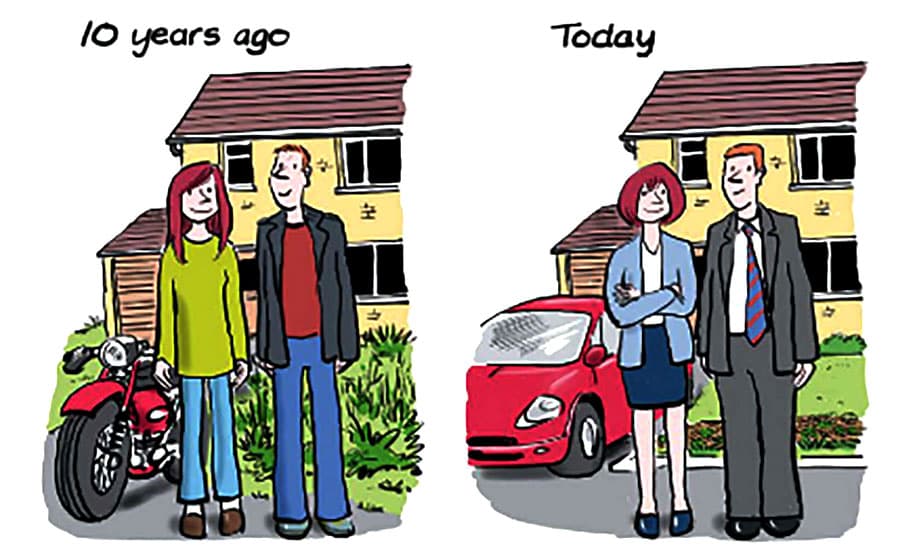
5. Look at the pictures of Mary and Jeff ten years ago and today. Write sentences about how they have changed. Use used to / didn’t use to and the words in brackets.
- 1)(Mary / have long hair)
- 2)(Jeff / be thinner)
- 3)(Jeff / wear suits)
- 4)(They / look after the garden)
- 5)(They / ride a motorbike)
- 6)(They / own a car)
6. Complete the sentences with used to and a verb in the box.
| walk be think spend not suffer not eat |
- 1)When I was a child I to school every day.
- 2)When I was a teenager, my parents I was lazy.
- 3)I from allergies, but now I do.
- 4)People in my country a lot of fast food, but they do now.
- 5)I more time outdoors than I do now.
- 6)The health service in my country better than it is now.
7. Complete the text with the correct form of used to and the verbs in the box.
| plan not be buy not open not have see |
- Thirty years ago, we (1) ) any big supermarkets in my town. There were some small shops and I (2) ) everything there. I liked it because I always (3) ) people I knew, so it was very friendly. But it wasn’t perfect – there (4) ) a lot of different products. And the shops (5) ) on Sunday or late in the evening, so I (6) ) my week carefully.
Como praticar
- 1Leia cada pergunta cuidadosamente
- 2Escreva sua resposta ou selecione a opção correta
- 3Clique em 'Mostrar Resposta' para verificar seu trabalho
- 4Revise quaisquer erros e tente exercícios similares
- 5Passe para o próximo exercício quando estiver pronto
Exercícios de prática relacionados
Aprenda com aulas
Construa sua base com aulas de áudio e vídeo