Adjectives – opposites : exercices de lexique A1
7 exercices de niveau A1 (Compétences Lexicales) sur « Adjectives – opposites », avec corrigés. Faites chaque activité et vérifiez tout de suite. Gratuit, sans compte.
Niveau (Compétences Lexicales)
Avant de commencer. 7 exercices. Remplissez chaque blanc, puis vérifiez vos réponses.
Exercice 1. Match the adjectives below to make pairs of opposites.
12 blancs- awful
- different
- difficult
- expensive
- fantastic
- good
- large
- low
- new
- safe
- true
- wrong
- 1bad
- 2great
- 3similar
- 4easy
- 5cheap
- 6false
- 7terrible
- 8high
- 9old
- 10right
- 11dangerous
- 12small
0 sur 12 répondues
Exercice 2. Complete the sentences with adjectives from exercise 1.
7 blancs- 1Don’t play with that knife. It isn’t
- 2£500 for a jacket? That’s !
- 3The shelf is very I have to stand on a chair to reach it.
- 4Well done! All the answers in your test are
- 5British English is a bit from American English.
- 6That calculation is very I can’t do it.
- 7Joe says he’s seventeen. But that isn’t He’s only fifteen.
0 sur 7 répondues
Exercice 3. Complete the adjectives. Use a, e, i, o, u and y. Which prefix do we add to make the adjectives negative?
19 blancs- 1fr ndl
- 2knd
- 3hpp
- 4td
- 5us l
- 6ncssr
- 7cmfrtbl
- Negative prefix:
Exercice 4. 4.Complete the labels with negative forms of adjectives from exercise 3.
5 blancs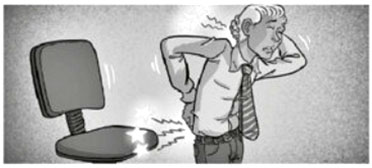
- 1an chair
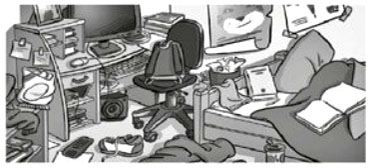
- 2an room
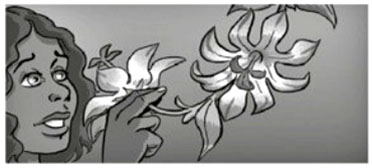
- 3an flower
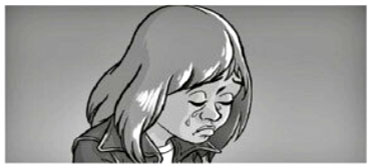
- 4an child
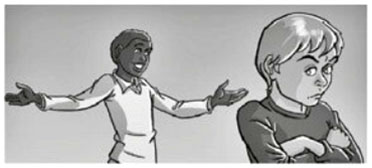
- 5an boy
Exercice 5. Choose three adjectives from exercises 1 and 3 that you could use to describe these things. Try not to use any adjective more than once.
15 blancs- a)Apair of jeans
- 1) 2) 3)
- a)Bcity
- 1) 2) 3)
- Can exercise
- 1) 2) 3)
- Dthe weather
- 1) 2) 3)
- a)Eclassmate
- 1) 2) 3)
VOCAB BOOST!
In entries for adjectives in most learner’s dictionaries you can often find the adjective with the opposite meaning. When you look up an adjective, make a note of the opposite too, if it is given.
Exercice 6. Read the Vocab boost! Box. Then study the dictionary entries below. Complete the pairs of adjectives.
6 blancs- 1awake Opposite:
- 2late Opposite:
- 3beautiful Opposite:
- 4thick Opposite:
- 5near Opposite:
- 6soft Opposite:
0 sur 6 répondues
Exercice 7. Complete the dialogues using the opposite adjectives.
9 blancs- 1AIs that jacket new?
- BNo, it’s
- 2AAm I right?
- BNo, you’re
- 3AIs chemistry easy?
- BNo, it’s
- 4AAre your boots similar to mine?
- BNo, they’re
- 5AIs that sport dangerous?
- BNo, it’s
- 6AIs that answer true?
- BNo, it’s
- 7AIs that a good idea?
- BNo, it’s very
- 8AAre their prices high?
- BNo, they’re quite
- 9AIs it a great film?
- BNo, it’s
0 sur 9 répondues
Exercices Connexes
Voir tous les exercices de Compétences Lexicales- Adjective + preposition6 exercices
- Do, make, have, take, bring6 exercices
- Introduction to phrasal verbs6 exercices
- Noun suffixes5 exercices
Apprenez avec des leçons
Écoutez un enregistrement et écrivez-le, une phrase à la fois
Comment Pratiquer
- 1Lisez chaque question attentivement
- 2Écrivez votre réponse ou sélectionnez l'option correcte
- 3Cliquez sur « Vérifier les réponses » pour corriger vos trous, ou sur « Afficher les réponses » pour voir le corrigé
- 4Examinez les erreurs et essayez des exercices similaires
- 5Passez à l'exercice suivant lorsque vous êtes prêt