A1
English Vocabulary Exercises for A1 – Wild animals
10 Übungen
Baue deinen A1 (Anfänger) Englisch-Wortschatz mit "English Vocabulary Exercises for A1 – Wild animals" auf. 10 interaktive Wortübungen mit sofortigem Feedback. Kostenlos, ohne Anmeldung.
1. Do the puzzle using the picture clues. What are the two hidden animals?
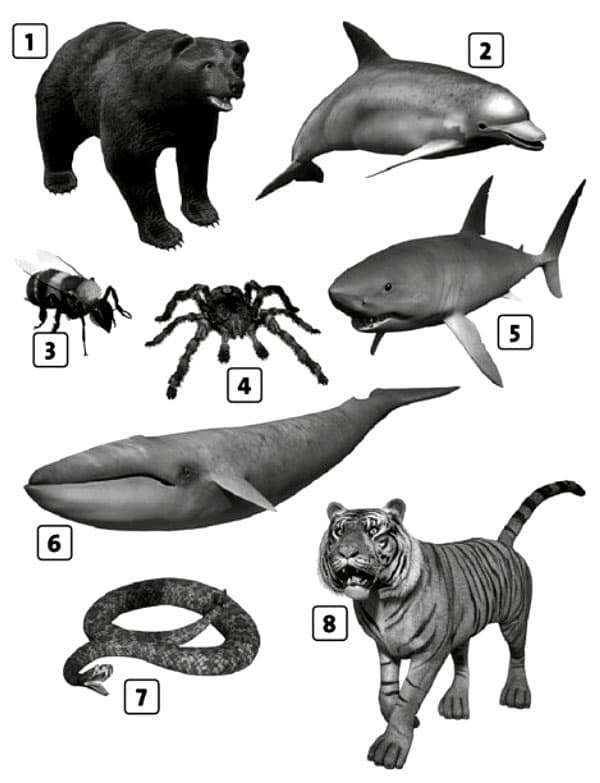
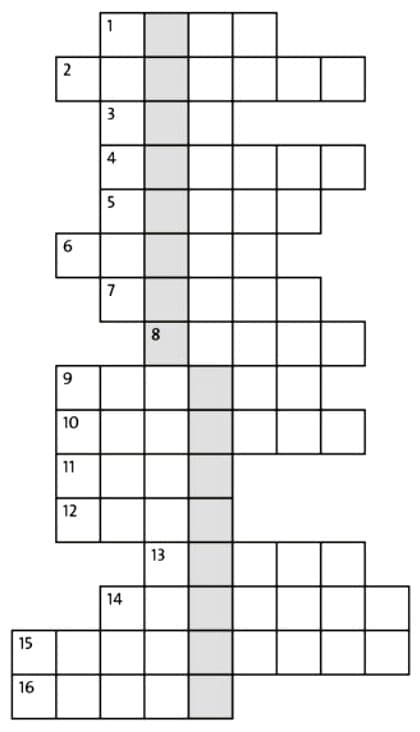
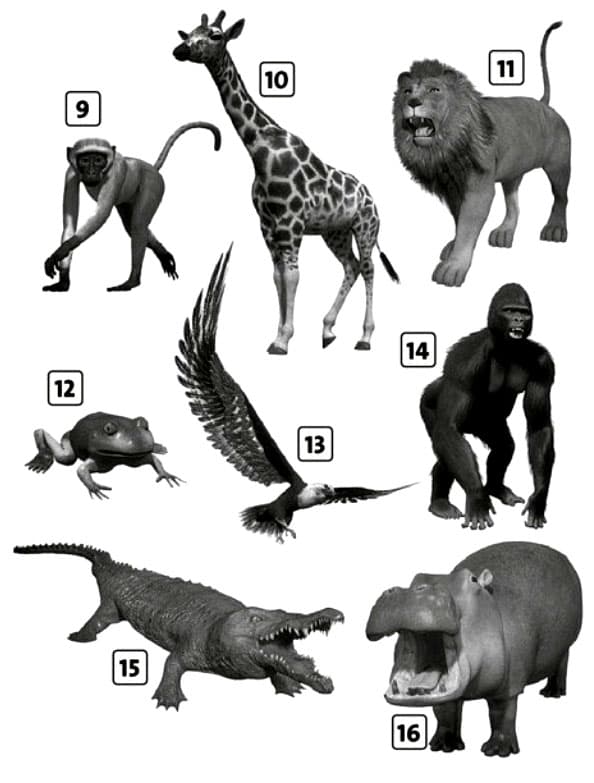
2. Look at the pictures of a wolf and a bird. Match items 1-8 in the pictures with the words below.
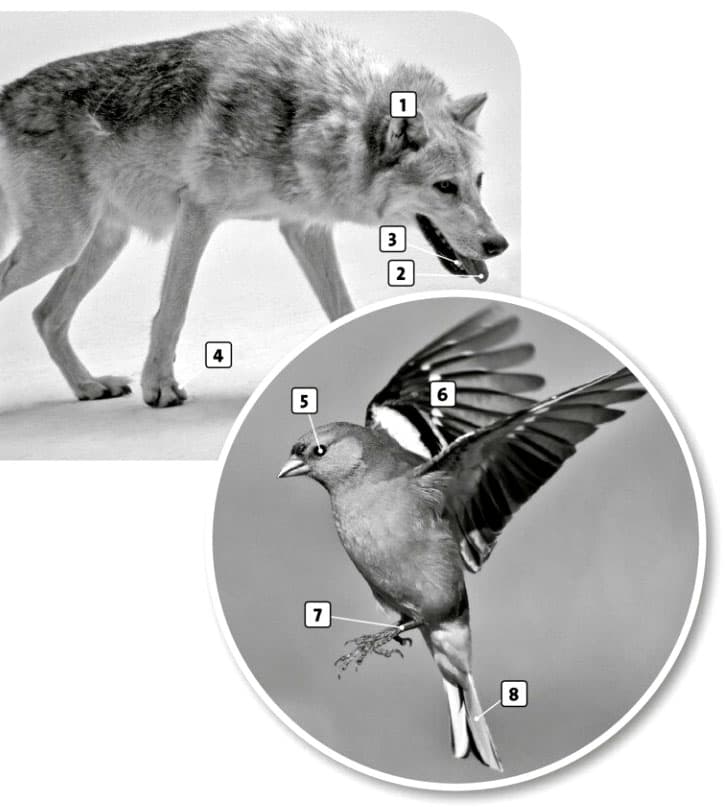
- ear legs
- paw tail
- eye mouth
- teeth wing
3. Answer the questions with animals from exercises 1 and 2.
- Which animals
- 1)haven’t got any legs?
- 2)have got wings?
- 3)have got six or eight legs?
- 4)have got four arms / legs and a tail?
4. Listen to four people describing animal photos. Which animal is each speaker talking about? Choose from the animals in exercise 1.
Audio
- Speaker 1 is describing a photo of a
- Speaker 2 is describing a photo of an
- Speaker 3 is describing a photo of a
- Speaker 4 is describing a photo of a
Extra exercises
5. Complete the definitions with six of the animals below.
- bee butterfly crocodile dolphin eagle elephant frog
- hippo shark snake spider wolf
- 1)A / An is an insect with big coloured wings.
- 2)A / An is a reptile with a long thin body and no legs.
- 3)A / An is a very big mammal from Africa or Asia with big ears and a long nose.
- 4)A / An is a large bird that can see very well.
- 5)A / An is a big fish that lives in the sea.
- 6)A / An is a small green animal that lives in and near water.
6. Answer the questions with parts of an animal.
- What does an animal use
- 1)to make sounds and to eat?
- 2)to fly?
- 3)to hear?
- 4)to see?
- 5)to walk and to stand?
7. Complete the sentences with ago, last or yesterday.
- 1)My grandparents arrived a few minutes
- 2)I watched a film on TV night.
- 3)My dad walked to work morning.
- 4)Maria started studying English ten years
- 5)We travelled to Canada summer.
8. Complete the sentences with the professions formed from the words in bold.
- 1)Joseph Pulitzer worked for different journals and newspapers. He was a
- 2)Marco Polo explored China and Central Asia. He was an
- 3)John F. Kennedy worked in politics in the 1950s and 60s. He was a
- 4)Captain James Cook was the first European to sail to Australia. He was a
- 5)Marie Curie was good at science, especially physics and chemistry. She was a
9. Complete the sentences.
- 1)It’s a beautiful day. There isn’t a cloud in the
- 2)In the Himalayas, there’s always snow on the
- 3)When I was a child, I loved playing with the sand on the
- 4)It was a clear night, so we could see the moon and all the
- 5)We stopped to have lunch on the grass under a
- 6)My sister doesn’t like driving in the dark, so she always tries to get home before
10. Match the first parts of sentences 1-6 with the second parts (a-f).
- 1)The women are walking
- 2)The boy is climbing
- 3)The children are lying
- 4)The girl is looking down
- 5)The men are facing
- 6)People are standing
- a)at the bus stop.
- b)at the floor.
- c)a tree.
- d)along a path.
- e)on the ground.
- f)the door.
So üben Sie
- 1Lesen Sie jede Frage sorgfältig
- 2Schreiben Sie Ihre Antwort oder wählen Sie die richtige Option
- 3Klicken Sie auf 'Antwort zeigen', um Ihre Arbeit zu überprüfen
- 4Überprüfen Sie Fehler und versuchen Sie ähnliche Übungen
- 5Fahren Sie mit der nächsten Übung fort, wenn Sie bereit sind
Verwandte Übungen
Lernen mit Lektionen
Bauen Sie Ihre Grundlagen mit Audio- und Videolektionen auf