A2
Practice Listening Business English Exercises for A2 – Work patterns
8 Übungen
Übe A2 (Elementar) Business-Englisch mit "Practice Listening Business English Exercises for A2 – Work patterns". 8 Übungen zur beruflichen Kommunikation mit sofortigem Feedback. Kostenlos, ohne Anmeldung.
1. Exercise 1
Audio
- A. Listen to three people talking about their work patterns. Make notes about their jobs and working hours.
- Speaker 1
- Speaker 2
- Speaker 3
2. Exercise 2
Audio
- A. Listen to Lou calling her colleague, Ian, about an appointment she made with him last week.
- 1)What date did Lou and Ian have an arrangement to meet?
- 2)Why is that date now not possible?
- 3)Does Lou want to make the appointment sooner or later? Why?
- 4)Who’s available on the following dates?
- a)Wed 10, morning: Lou / Ian
- b)Wed 10, afternoon: Lou / Ian
- c)Thu 11, afternoon: Lou / Ian
- d)Fri 12, afternoon: Lou / Ian
- 5)What does Ian offer to do to help?
- B. In their conversation, Lou apologises for changing the meeting time, while Ian tries to be helpful. Listen again and note down examples of what they say.
3. Exercise 3
Audio
- A. Ian immediately calls his assistant, James. Listen and note down the changes they make to Ian’s schedule.
- B. Ian is more direct with James than Lou. Why do you think that is?
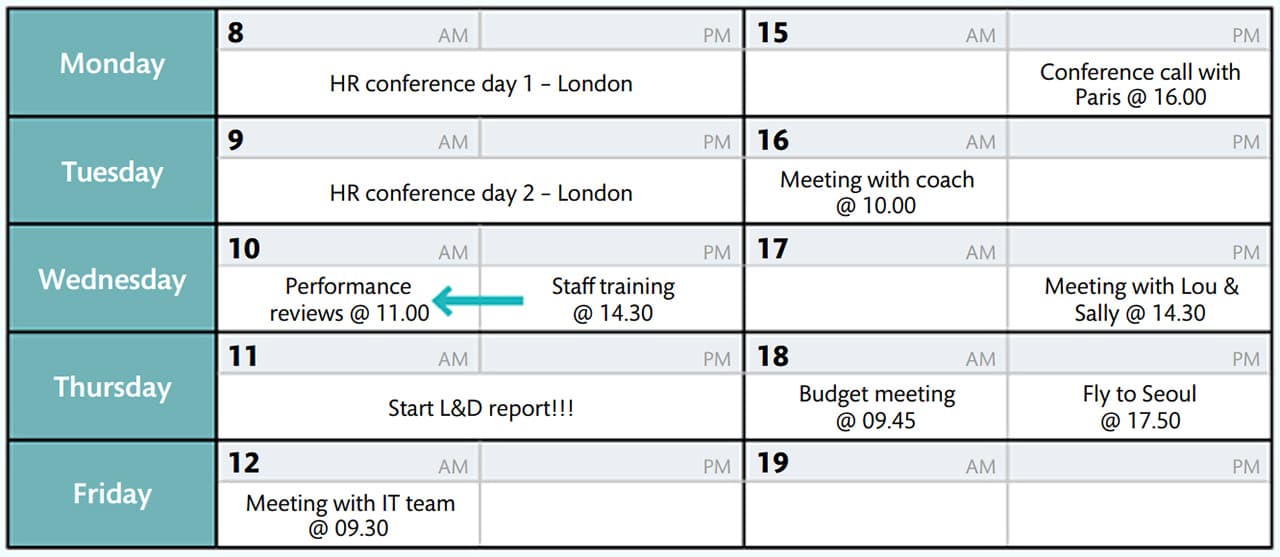
C. Listen to Ian calling Lou back to confirm the details. Make brief notes.
MEETING PLANNER | Ian Henderson
Arrangements: ………………………………………
4. Exercise 4
Audio
- A. Listen to Clara Olsen giving a presentation to the senior managers in Madrid about the company culture at Holsted. Find one difference between each point below and the presentation.
- The Holsted company culture
- 1)Employees work 40 37 hours a week from Monday to Friday.
- 2)They are often expected to work long hours.
- 3)The working hours are fixed for most employees.
- 4)The work culture is very strict but effective.
- 5)Managers are responsible for how employees organise their time and projects.
- 6)Senior staff in the company can tell us their ideas and opinions.
- 7)It’s important to arrive on time for work; it shows you are professional.
5. Exercise 5
Audio
- A. Listen to part of a meeting between Clara Olsen, Vice President; Marina Beltran, Human Resources Manager; and Álvaro Martínez, Finance Manager; in Madrid. Look at Clara’s list of questions. Which questions are they discussing?
- MEETING ABOUT WORK PATTERNS
- 1)What types of contracts are there? (full-time, part-time?)
- 2)How much holiday do employees get?
- 3)What are the working hours – start time, finish time?
- 4)Does the company let employees work flexible hours?
- 5)How long is the lunch break?
- 6)Can employees work from home?
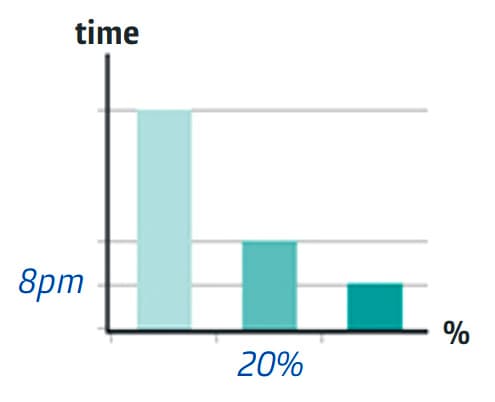
- B. Listen again and complete this extract from the meeting (0:00–0:32). Then complete the bar chart with the correct percentages and times.
- As you can see from this bar graph, the working day is very long here in the Madrid office. On an average day only (1) ) of our employees leave work by (2) ) o’clock. At (3) ) o’clock, (4) ) percent of the staff are still here in the office and (5) ) percent are still at their desks at (6) ) in the evening.
- C. Work in pairs. What is a suitable title for the graph?
- D. Listen to the rest of the meeting again (0:32–2:19) and answer the questions.
- 1)What does Álvaro say about the lunch break?
- 2)What do Marina and Álvaro disagree about?
- 3)What does Marina say about staff working long days?
- 4)What risks does she say are possible?
6. Exercise 6
Audio
- A. Listen to an interview with a student and tick the jobs she does.
- 1)working as a chef
- 2)taking food orders
- 3)serving food in restaurants
- 4)pouring drinks at events
- 5)delivering fast food
- 6)delivering parcels
- 7)working as a hotel receptionist
- 8)working in a pharmacy
- 9)working as a domestic cleaner
- 10)promoting holiday events
- B. Listen again and decide if the statements are true (T) or false (F).
- 1)Amy doesn’t have to pay rent.
- 2)The flexibility of the gig economy is good for Amy.
- 3)Amy doesn’t like working for the catering company.
- 4)The interviewer doesn’t think being a bike courier is safe.
- 5)Amy often delivers food to office staff.
- 6)After she finishes university, Amy wants a job that offers training and a pension.
- C. Listen again and complete the sentences with one word.
- 1)Amy is studying at the moment.
- 2)She wants to work in the industry when she graduates from university.
- 3)She needs to earn money to pay and buy food and clothes.
- 4)When she has , she works less or stops working for a while.
- 5)She says that some of her are also working in the catering and hospitality industry.
- 6)She has done a lot of cycling and has never had an .
- 7)As a courier, she often delivers parcels or .
- 8)She is happy to carry on working in the economy while she is a student.
- D. Choose the sentence which best describes Amy.
- a)She’s hard-working and wants an interesting and secure job in the future.
- b)She’s relaxed about work and would like to continue working for different companies.
- c)She’s happy to work in a dangerous environment.
7. Exercise 7
Audio
- A. Complete the dialogue between Pavel and Laila with the phrases in the box. Then listen and check.
- P: Pavel Orlov speaking.
- L: Pavel, hi. It’s Laila.
- P: Hi, Laila. What can I do for you?
- L: Well, (1) ) our meeting on Tuesday next week.
- P: You mean, the 12th? Do you want (2) )?
- L: No, no. It’s just that I’ve got a bit of a problem. You see, there’s a training session at our head office on Tuesday and I really have to be there.
- P: That’s OK. Don’t worry.
- L: I know it’s a bit (3) ) .
- P: No, that’s fine.
- L: So (4) ) we fix another time to meet?
- P: Fine. Let me just (5) )I’m free on Friday the 15th. How does the morning suit you?
- L: Oh sorry, Pavel. I’m busy all day on Friday. How about Thursday?
- P: No, sorry, Thursday’s (6) ), I’m afraid. All-day meeting
- L: OKUm, can we bring (7) ), maybe? How about Monday the 11th?
- P: Yeah, Monday’s good.
- L: Great. (8) ) for you: morning or afternoon?
- P: Morning’s fine.
- L: Right. So just (9) ): the meeting will be on Monday the 11th.
- P: Yes, Monday morning. 9.30?
- L: Perfect. Thanks for being (10) ), Pavel. I appreciate it.
- P: No problem. See you then.
| check my schedule do you mind if I’m calling aboutit forward out for me short notice so flexibleto confirm to postpone it which is better |
8. Test
Audio
- 1)You will hear eight short recordings twice. For questions 1–8 choose the correct answer.
- 1)How many days a week does the man work?
- a)3
- b)5
- c)7
- 2)What does the man do at lunchtime?
- c) 3) Who is going to finish preparing the presentation?
- a)Sandra
- b)Dmitri
- c)Rens
- 4)What kind of work is the company offering?
- a)permanent
- b)flexible hours
- c)full time
- 5)What do the man and woman decide to do about the staff party?
- a)delay it until summer
- b)book a restaurant now
- c)ask for different ideas
- 6)What is the new meeting date?
- a)Monday 6 June
- b)Wednesday 8 June
- c)Monday 13 June
- 7)What was the woman’s first job?
- a)a shop assistant
- b)delivering newspapers
- c)cleaner
- 8)Where are they going to meet?
- c





So üben Sie
- 1Lesen Sie jede Frage sorgfältig
- 2Schreiben Sie Ihre Antwort oder wählen Sie die richtige Option
- 3Klicken Sie auf 'Antwort zeigen', um Ihre Arbeit zu überprüfen
- 4Überprüfen Sie Fehler und versuchen Sie ähnliche Übungen
- 5Fahren Sie mit der nächsten Übung fort, wenn Sie bereit sind
Verwandte Übungen
Lernen mit Lektionen
Bauen Sie Ihre Grundlagen mit Audio- und Videolektionen auf